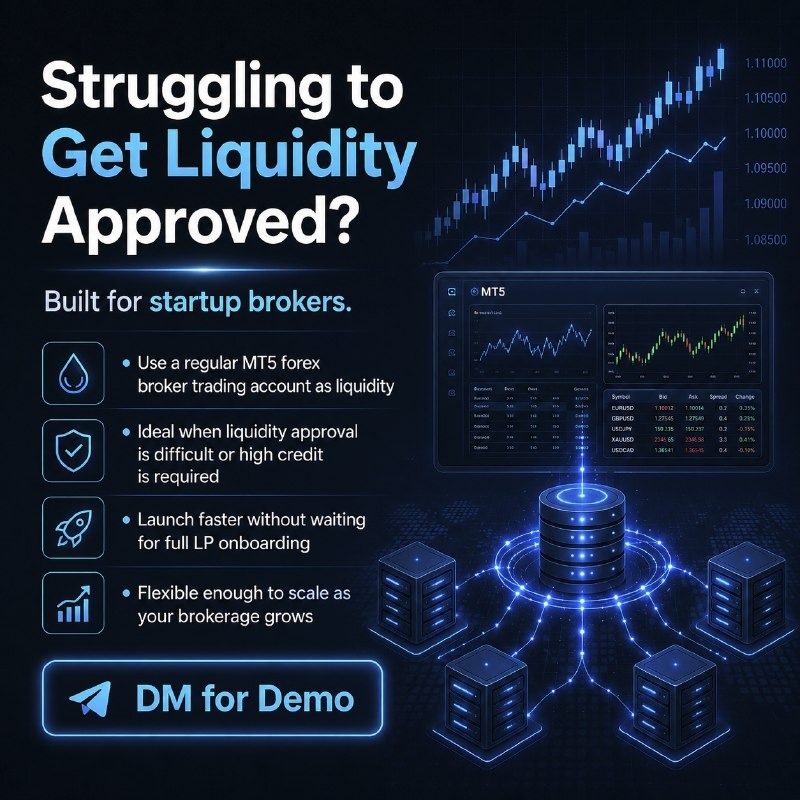
One of the hardest problems a startup forex broker faces is getting liquidity. Established liquidity providers typically require a track record, a licensed entity, and minimum volume commitments — barriers that effectively shut out new entrants. A forex liquidity bridge built around an MT5 trading account changes that equation entirely.
What Is a Forex Liquidity Bridge?
A liquidity bridge is software that sits between your MT4 or MT5 server and a liquidity source. When a client places a trade on your platform, the bridge routes that order to the liquidity provider — or your internal book — according to predefined execution rules. The client sees a seamless execution; under the hood, the bridge manages order flow, pricing, and risk exposure.
The Startup Liquidity Problem
Traditional liquidity providers — banks, prime brokers, ECNs — require brokers to pass an onboarding process that includes legal documentation, regulatory licensing, and volume guarantees. A startup broker with no trading history and no regulated entity will be rejected by most tier-one and tier-two LPs.
This creates a classic catch-22: you need liquidity to launch, but you cannot get liquidity without a track record.
The MT5 Account Solution
The ForexPlatforms.Pro Liquidity Bridge solves this with a practical approach: use a regular MT5 forex broker trading account as your liquidity source. Any individual or company can open an MT5 account with an existing broker — no LP approval process, no volume commitment, no regulatory entity required.
Your bridge connects to this MT5 account as the upstream, routing your firm’s order flow through a live, liquid market from day one.
Core Bridge Features
- MT5 account as liquidity — Use any standard MT5 trading account as your upstream source immediately
- FIX Protocol support — Connect to traditional institutional liquidity providers when you are ready to scale
- Multiple liquidity destinations — Map different client groups to different liquidity sources
- Execution rules engine — Configure reverse trading, symbol filtering, account filtering, and volume range rules on the fly
- Custom routing — Route specific accounts or entire MT5 groups to specific liquidity sources
Execution Rules: Managing Risk Intelligently
Not all order flow should be treated equally. A bridge with a flexible rules engine lets you internalize low-risk retail flow, hedge large or concentrated positions externally, filter which symbols are routed upstream, and apply reverse trading for specific account types. This level of control is what separates a professional-grade bridge from a simple pass-through relay.
FIX Protocol: The Path to Scaling
As your broker grows and your volume justifies a direct LP relationship, the bridge supports FIX Protocol natively. You switch or add a liquidity source without replacing your infrastructure — the same bridge scales with your business.
Setup and Pricing
Bridge setup completes within 24 hours for standard configurations. The monthly subscription model means no long-term commitment while you validate your model and build your client base.
Struggling to get liquidity approved? The Liquidity Bridge for Startup Brokers was built specifically for this problem.
Related Guides
- How to Choose a Forex Liquidity Provider — pricing depth, fill quality, terms, and counterparty risk
- Liquidity Bridge vs Aggregator — when aggregation actually earns its cost
Frequently Asked Questions
Q: What is a forex liquidity bridge?
A: A forex liquidity bridge is software that connects your MT4 or MT5 trading server to a liquidity provider. It routes client orders to the LP for A-Book execution, handles FIX protocol translation, and manages your B-Book/A-Book execution rules in real time.
Q: Do startup forex brokers need a liquidity bridge?
A: Not on day one. Most startups launch in B-Book mode and add a liquidity bridge when monthly volume reaches LP minimums — typically $200M to $500M per month for tier-2 providers. A bridge becomes necessary when position concentration risk needs hedging.
Q: What is the difference between A-Book and B-Book execution?
A: In B-Book execution, the broker internalises trades and takes the opposite side. In A-Book execution, trades are routed to a liquidity provider via the bridge and the broker earns spread markup without market risk. Most growing brokers use a hybrid model.