When you start a forex broker, one of the most consequential decisions you will make is your execution model. Every trade that flows through your platform must go somewhere — and where it goes determines your risk profile, your profitability, and the technology you need to build.
The two fundamental models are A-book and B-book. Most professional brokers operate a hybrid of both. Here is how each works, the trade-offs between them, and which makes sense for a startup.
What Is an A-Book Forex Broker?
In an A-book model — also called STP (Straight-Through Processing) — the broker passes every client trade directly to a liquidity provider (LP). The broker acts as an intermediary, not a market maker.
How it works:
- A client places a trade on your MT4/MT5 platform.
- Your MetaTrader Manager API routes the order through a liquidity bridge to your LP.
- The LP fills the order at market price.
- You earn a spread markup or commission per lot traded.
Advantages:
- Zero market risk — you never take the other side of a trade
- Regulatory preference — FCA, ASIC, and CySEC strongly favour STP/A-book models
- No conflict of interest with clients
- Unlimited volume scalability with no internal risk desk
Disadvantages:
- Requires an LP relationship — difficult for startups to obtain without trading history
- Requires a liquidity bridge as infrastructure
- Revenue is commission-based and depends entirely on volume
- LP minimum deposit requirements ($50,000–$250,000) add to startup capital needs
What Is a B-Book Forex Broker?
In a B-book (market maker) model, the broker takes the other side of every client trade internally. There is no external LP involved — the broker effectively becomes the counterparty.
How it works:
- A client opens a trade on your platform.
- The broker’s system accepts and internalises the risk.
- If the client loses, the broker profits; if the client wins, the broker pays from its own capital.
- Revenue is the aggregate of client losses minus client wins, plus spread.
Advantages:
- Higher per-trade margin — you capture the full spread plus client losses
- No LP relationships required — you can launch without LP approval
- No liquidity bridge infrastructure needed initially
- Lower technology complexity for early-stage operations
Disadvantages:
- Full market risk — large winning traders can cause significant losses to your book
- Conflict of interest perception with clients (you profit when they lose)
- Regulators increasingly scrutinise pure B-book operations
- Requires capital reserves to absorb client winning streaks
A-Book vs B-Book: Side-by-Side Comparison
| Feature | A-Book (STP) | B-Book (Market Maker) |
|---|---|---|
| Revenue source | Spread / commission per lot | Client losses + spread |
| Market risk | None | High |
| LP relationship required | Yes | No |
| Liquidity bridge required | Yes | No |
| Regulatory preference | Strong | Low (increasingly restricted) |
| Capital at risk | No | Yes (client wins) |
| Profit when client wins | Yes (still earn commission) | No (pay out) |
| Startup complexity | Higher | Lower |
| Best for | Regulated, high-volume brokers | Early-stage, offshore brokers |
The Hybrid Model: How Most Brokers Actually Operate
Very few professional brokers are pure A-book or pure B-book. The vast majority operate a hybrid — sometimes called a C-book internally:
- Small, statistically unprofitable accounts → B-booked (LP cost unjustified on small trades)
- Large accounts / high-frequency traders / consistent winners → A-booked (risk too high to hold internally)
- Volatile news events → Winning clients temporarily routed A-book
- Exotic instruments → Often B-booked; major FX pairs A-booked
This approach maximises profitability on the statistically losing majority while controlling tail risk from outlier traders.
Technology Required for Each Model
For A-book execution, you need:
- MT4/MT5 trading server
- A liquidity bridge connecting your MT5 server to your LP via FIX connectivity
- A Manager API for account management, reporting, and trade automation
- An LP-approved legal entity and margin deposit
For B-book execution, you need:
- MT4/MT5 trading server
- A forex broker CRM for back-office management, deposits, and KYC
- Internal risk monitoring (manual or semi-automated via the Manager API)
- Capital reserves to cover client winning exposure
For hybrid routing: All of the above plus bridge-level routing rules that classify accounts and route orders automatically based on account size, trading history, and instrument type.
Which Model Should You Start With?
For most startup brokers, the pragmatic answer is: start B-book, build toward hybrid.
Here is the reasoning:
- You cannot get LP approval without a track record. Tier-1 and most tier-2 LPs require 6–12 months of operating history and minimum volume commitments. A startup cannot meet these requirements on day one.
- B-book is operationally simpler. No bridge, no LP margin, no FIX connectivity to configure. You can go live faster with a clean CRM and MT5 server.
- Risk is manageable with account limits. B-booking accounts under a defined notional limit (e.g., $1,000 balance or $0.1 lot maximum) keeps your exposure controlled while you build history.
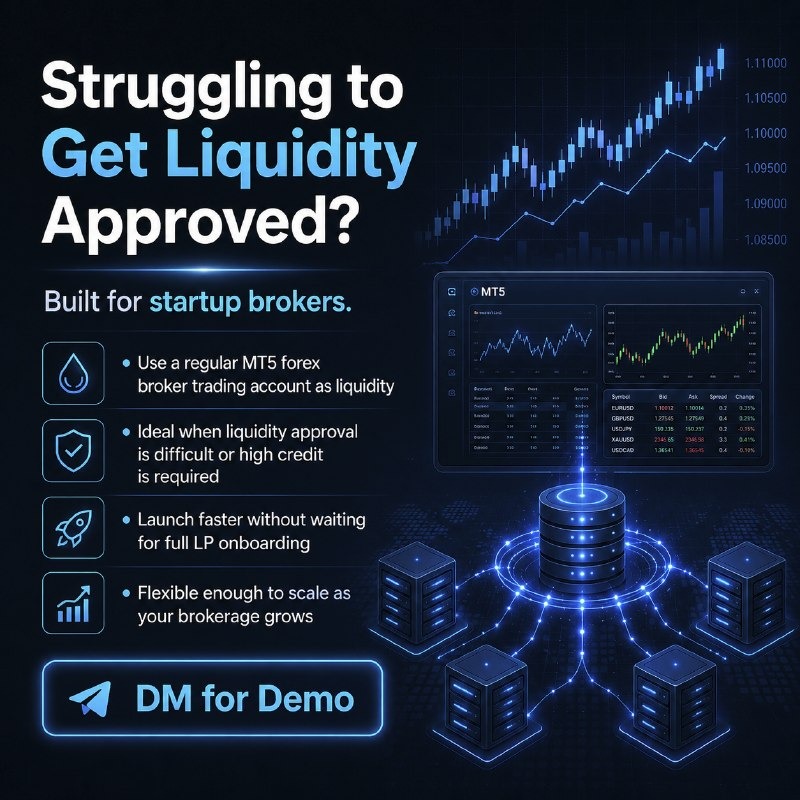
- The bridge is ready when you are. Platforms like the ForexPlatforms.Pro liquidity bridge are designed for startup-friendly LP access. You can add A-book routing as your business grows without rebuilding your technology stack.
Related Guides
- How to Choose a Forex Liquidity Provider — pricing depth, fill quality, terms, and counterparty risk
Frequently Asked Questions
Q: Is B-book forex brokerage legal?
A: Yes, in most jurisdictions the B-book (market maker) model is legal and widely used. Many major regulated brokers operate as partial market makers. The key requirement is disclosure of your execution model in client terms and risk documentation.
Q: What liquidity providers work with startup brokers?
A: Tier-3 and regional LPs are more startup-friendly, often accepting minimum deposits of $10,000–$50,000. Once you demonstrate 3–6 months of consistent volume, you can negotiate with tier-2 providers. The MT5-based liquidity bridge at ForexPlatforms.Pro is specifically designed for startup-friendly LP access.
Q: Do I need to disclose my execution model to clients?
A: In most regulated jurisdictions, yes. FCA, ASIC, and CySEC-regulated brokers must clearly state their execution policy — including whether they act as principal (B-book) — in their Client Agreement and Order Execution Policy.
Q: Can I switch from B-book to A-book later?
A: Yes. If your platform supports a liquidity bridge, switching or adding A-book routing is a configuration change, not a technology rebuild. Most white label platforms support hybrid routing rules from the start.