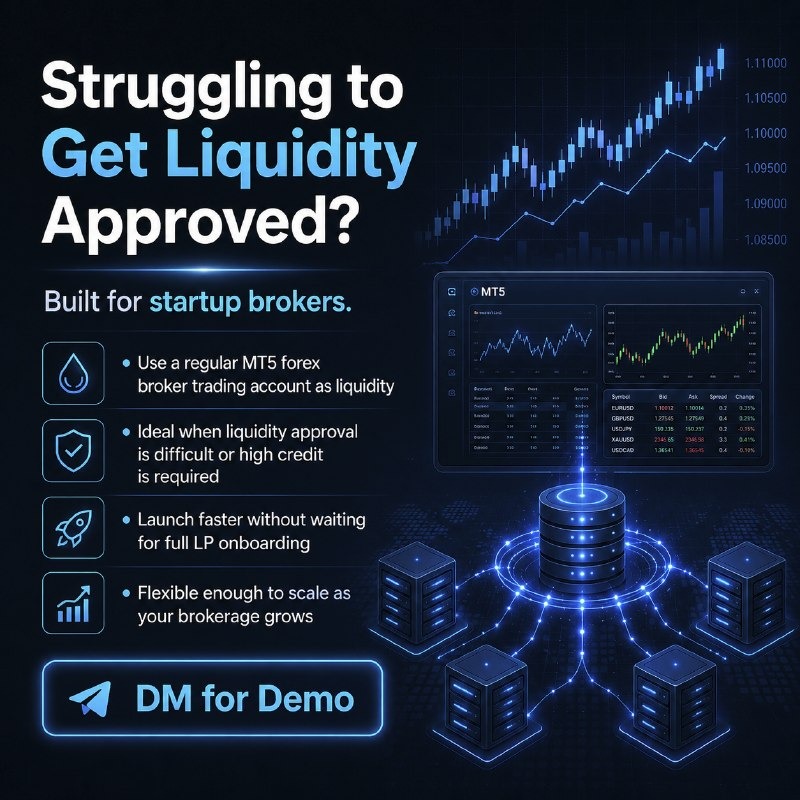
One of the first questions every new forex broker asks is: how do I get liquidity? The answer is more complicated than most people realize — and for startup brokers specifically, the conventional path to a tier-1 liquidity provider is often not accessible on day one. A liquidity bridge for startup brokers is the practical solution that bridges that gap while you build volume and credibility.
This guide explains how forex liquidity actually works, why startups face unique challenges getting it, and what an MT5-based liquidity bridge delivers in practice.
Why Startup Brokers Struggle to Get Liquidity
Institutional liquidity providers — the banks and prime brokers that supply tight spreads and deep order books — are not interested in working with brokers who have no track record. The due diligence requirements typically include:
- Minimum monthly volume commitments — Most tier-1 LPs require between $500M and $1B per month in notional volume. A startup broker will not come close to this in the first year.
- Security deposits — LPs typically require a security deposit of $100,000 to $500,000 as collateral against client defaults.
- Regulatory requirements — Many institutional LPs will only work with regulated entities in recognised jurisdictions.
- Technology requirements — You need a FIX API-capable trading server and a properly configured liquidity bridge to even connect to an LP price feed.
For a broker in their first year, most of these requirements are simply out of reach. This is not a barrier unique to small brokers — even well-funded startups frequently launch in B-Book mode and transition to A-Book as volume grows.
B-Book vs A-Book: Where Startup Brokers Actually Start
Understanding the two fundamental execution models helps clarify when a liquidity bridge becomes necessary:
- B-Book (market maker) — The broker takes the other side of client trades internally. Client profits come from broker capital; client losses go to broker capital. No LP is involved. The risk is that a cluster of winning clients can hurt profitability, but for a startup with small client positions this is manageable and avoids the LP relationship entirely.
- A-Book (straight-through processing) — Client orders are routed directly to an LP via the liquidity bridge. The broker earns markup on the spread without taking market risk. This requires a live LP relationship and a properly configured bridge.
- Hybrid model — The most common approach for growing brokers. Smaller retail positions are B-Booked internally. Larger positions above a defined threshold are A-Booked to the LP to cap the broker risk exposure.
Most startup brokers launch in B-Book and introduce a liquidity bridge when they reach the volume thresholds that make an LP relationship viable.
What a Liquidity Bridge Actually Does
A liquidity bridge sits between your MT4 or MT5 trading server and your liquidity provider. When a client places a trade on your platform, the bridge decides — based on your configured rules — whether to internalise that trade or route it to the LP. For A-Booked trades, the bridge:
- Receives the trade from the MT server
- Converts it to FIX protocol and sends it to the LP
- Receives the LP confirmation and passes it back to the MT server
- Handles aggregation across multiple LPs if you have more than one
- Manages netting, hedging, and risk reports in real time
The entire round-trip happens in milliseconds. From the client perspective, their trade executes normally. From your perspective, your market risk on that position is eliminated.
Why MT5 Is the Right Platform for a Liquidity Bridge
MT4 can connect to LPs via a bridge, but MT5 is significantly better suited for it:
- Native FIX API support — MT5 supports the FIX protocol natively, which is the industry standard for LP connectivity. MT4 requires a third-party bridge component to handle FIX translation.
- Multi-asset support — MT5 handles forex, metals, indices, equities, and futures in a single server. If you want to offer instruments beyond forex CFDs, MT5 is the only viable path.
- Better risk management tools — MT5 server-side risk management features are more sophisticated, which matters when you are managing a hybrid book.
- LP compatibility — A growing number of institutional LPs now offer MT5-native connectivity and will quote tighter spreads for MT5 clients than MT4.
What the ForexPlatforms.Pro Liquidity Bridge Includes
The MT5-based liquidity bridge for startup brokers includes:
- A-Book STP and ECN routing — Direct order routing to your connected LP with full FIX protocol support
- Configurable risk rules — B-Book and A-Book routing rules by account group, symbol, trade size, and client tier
- Multi-LP aggregation — Connect to multiple liquidity providers and aggregate their price feeds for best execution
- Real-time reporting — P&L by execution model, slippage reports, LP performance tracking, and position exposure by symbol
- Prop trading compatibility — Works alongside the prop challenge system for firms that run both funded accounts and retail operations
When Does a Startup Broker Actually Need a Liquidity Bridge?
The honest answer: not on day one for most startups. A liquidity bridge is the right investment when:
- Your monthly notional volume is approaching LP minimums, typically $200M to $500M per month for most tier-2 LPs
- You have a single large client or client cluster whose positions represent significant risk concentration that you need to hedge
- Regulatory requirements in your jurisdiction mandate A-Book execution for retail clients
- You are building a prop trading firm and need to hedge the funded trader book
In the meantime, launching B-Book with a full Forex CRM and growing your client base is a legitimate and common startup path. The infrastructure to add a liquidity bridge later does not need to be in place on day one — but the trading server and CRM should be, because migrating those later is expensive.
Getting Started
Whether you need a liquidity bridge for your startup broker now or are planning for it in six months, the right time to understand your options is before you build your technology stack — not after. The full broker package is designed to work alongside liquidity bridge integration from day one, so adding A-Book execution later is a configuration step rather than a rebuild.
Related Guides
- How to Choose a Forex Liquidity Provider — pricing depth, fill quality, terms, and counterparty risk
- Liquidity Bridge vs Aggregator — when aggregation actually earns its cost
Frequently Asked Questions
Q: What is a liquidity bridge for startup forex brokers?
A: A liquidity bridge connects an MT4 or MT5 trading server to a liquidity provider, routing client orders for A-Book execution. It handles FIX protocol translation, multi-LP price aggregation, and B-Book/A-Book hybrid routing rules.
Q: Do startup brokers need a liquidity bridge from day one?
A: No. Most startups launch in B-Book (market maker) mode and introduce a liquidity bridge when monthly volume reaches LP minimums — typically $200M to $500M per month. Adding a bridge is a configuration step when the time comes, not a full rebuild.
Q: What is the difference between B-Book and A-Book execution?
A: B-Book: the broker internalises trades and takes the opposite side — no LP required, but the broker carries market risk. A-Book: trades are routed to an LP via the bridge and the broker earns spread markup with no market risk. Most growing brokers use a hybrid model.
Q: Why is MT5 recommended for a liquidity bridge over MT4?
A: MT5 has native FIX API support — the industry standard for LP connectivity. MT4 requires a third-party bridge component for FIX translation. MT5 also supports multi-asset trading and has more advanced server-side risk management tools.